Chinese tech workers are starting to train their AI doubles

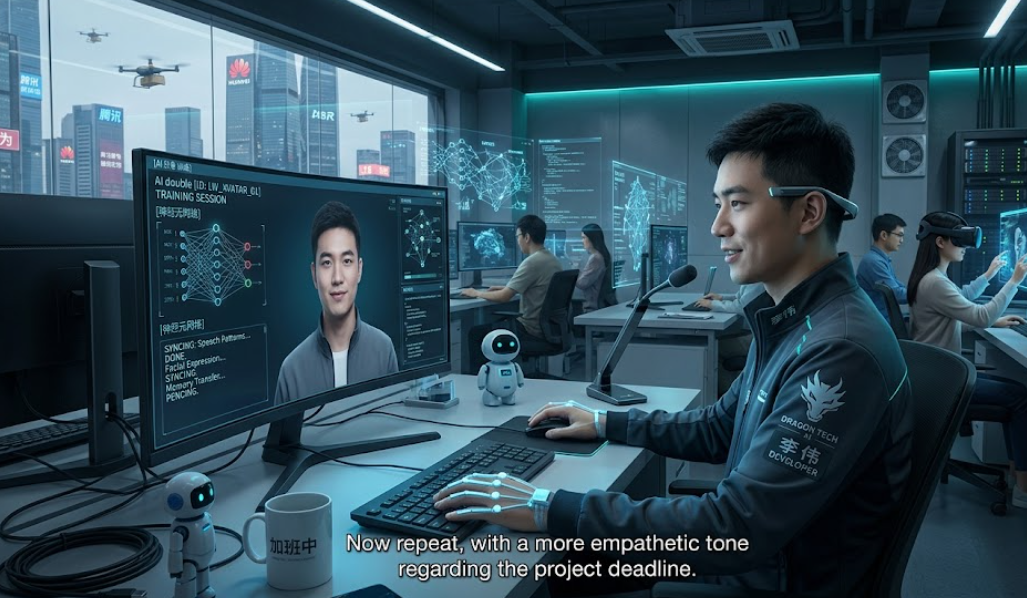
Chinese technology workplaces are experiencing a shift driven by AI agent systems that replicate employee workflows. Tools inspired by GitHub experiments are encouraging companies to document human work in structured digital formats. This change is reshaping job expectations, automation boundaries, and worker identity inside modern software teams.
Chinese tech workers are starting to train their AI doubles
The rise of AI double training in Chinese tech workplaces is creating operational efficiency goals and employee resistance at the same time. Companies are asking workers to document tasks, decision flows, and communication patterns so AI agents can replicate routine execution.
The core problem is job abstraction. Employees are converting lived experience into structured instructions for machines. This process reduces complex human judgment into repeatable steps. Many workers feel this reduces professional value and increases replaceability risk.
A practical response is structured participation. Employees benefit from documenting workflows with clarity while protecting context that depends on human judgment. Teams can separate automatable tasks from creative or strategic tasks. This distinction preserves essential human roles while still allowing safe AI adoption.
Companies can also introduce transparency policies. Workers should know how AI models use their data. Clear boundaries reduce mistrust and support controlled automation instead of uncontrolled replacement dynamics.
How AI skill cloning tools operate in workplaces
AI skill cloning tools function by capturing digital work behavior and converting it into reusable task models. These systems rely on workplace data sources and structured workflow extraction.
Data sources used for AI replication
AI systems use chat logs, project files, and task histories. Workplace platforms such as Lark and DingTalk provide communication data. These datasets form the base for building behavioral patterns of employees.
Agent creation and workflow conversion
The system processes employee actions into step-based instructions. It maps decision patterns, response styles, and task sequences. The output becomes a digital agent that can perform predefined functions with minimal supervision.
Integration with development ecosystems
Tools such as GitHub-based experimental projects and AI coding systems like OpenClaw and Claude Code support deployment. These tools connect AI agents with coding environments, debugging tasks, and communication workflows inside engineering teams.
Impact on employees and workplace identity
AI replication systems are changing how employees perceive value and identity inside technology companies. The shift is not only technical. It is psychological and structural.
Job security concerns in AI-driven workplaces
Employees face uncertainty when their tasks become machine-readable. Automation increases fear of replacement even when systems are not fully reliable. Workers begin questioning long-term career stability in software roles.
Reduction of work into modular tasks
AI systems break complex roles into smaller components. This creates efficiency for companies. However, it removes context from decision-making. Human expertise becomes harder to distinguish from machine output.
Psychological and professional effects
Workers report emotional detachment when their work is converted into machine instructions. The sense of ownership over outcomes declines. This leads to reduced motivation and weaker professional identity over time.
Corporate advantages and productivity goals
Organizations adopt AI replication systems to improve efficiency, reduce costs, and standardize performance across teams. These goals drive rapid experimentation in AI-driven workflows.
Workflow standardization for operational efficiency
Companies use AI to standardize repetitive tasks. Standardization reduces dependency on individual employees. It also improves scalability across large engineering teams and distributed systems.
Data collection for organizational intelligence
AI systems collect structured behavioral data from employees. This data helps companies identify bottlenecks and improve internal processes. It also supports training future AI models for enterprise automation.
Limits of automation in real environments
AI agents still struggle with unpredictable scenarios. Human oversight remains necessary for debugging, strategic decisions, and ambiguous tasks. Full replacement is not yet technically reliable in most business environments.
Legal and ethical considerations in AI workforce replication
AI-based employee replication introduces legal uncertainty around data ownership, identity rights, and workplace surveillance boundaries. These issues are becoming central in technology governance discussions.
Ownership of workplace communication data
Companies often claim ownership of chat logs and work files. Platforms like Lark and DingTalk store employee communications. However, these records may also contain personal expression and behavioral patterns.
Identity and personality representation risks
AI systems can replicate communication style and decision patterns. This raises questions about whether personality traits can be treated as corporate assets. The boundary between work output and personal identity becomes unclear.
Policy gaps in AI-driven employment systems
Current labor regulations do not fully address AI replication of employees. Companies operate in a gray area where automation tools evolve faster than legal frameworks. This creates uncertainty for both employers and workers.
Future of AI coworkers in the tech industry
AI coworkers are likely to expand across engineering, support, and administrative roles. Adoption will depend on reliability, governance, and employee trust. Hybrid systems combining human judgment and AI execution will remain dominant in the near term.
Future workplace models will prioritize collaboration between humans and agents. Employees will shift toward supervision, verification, and strategic decision-making roles. AI will handle structured execution tasks while humans manage exceptions and creative problem-solving.
Conclusion
AI-driven workplace replication is transforming how technology teams define work, skill, and productivity. Companies gain structured efficiency through automation systems. Employees face challenges in identity preservation and job clarity. The balance between innovation and human value continues to evolve across modern digital workplaces.