Samsung Electronics Marks 20 Consecutive Years as the World’s No.1 TV Brand

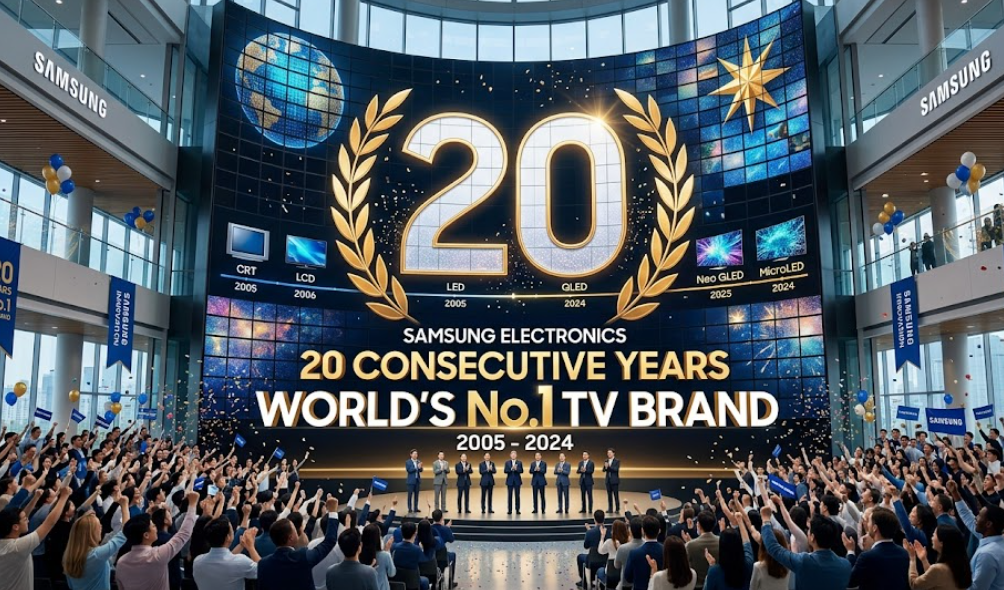
Samsung Electronics has confirmed its position as the global television leader for twenty consecutive years based on 2025 market data. The company continues to dominate the TV industry through innovation in display engineering, artificial intelligence processing, and premium screen development. Market research reports show strong performance across global premium and mass market television categories.
Consumer Problem and Samsung Electronics Market Solution
Consumers face difficulty when selecting televisions due to complex specifications, pricing differences, and rapidly changing display technologies. Samsung Electronics addresses this challenge through clear product segmentation and consistent innovation across all categories.
Samsung Electronics offers televisions for entry level users, mid range buyers, and premium customers. This reduces confusion in decision making and ensures compatibility with different budgets and room sizes.
Samsung Electronics also solves performance expectations through advanced display technologies. Neo QLED, OLED, and MICRO LED systems improve brightness, contrast, and color accuracy. These technologies deliver stable performance across sports viewing, gaming, and cinema usage.
Samsung Electronics integrates artificial intelligence processing into modern televisions. AI systems automatically adjust sound quality, picture clarity, and motion processing based on content type. This removes the need for manual calibration and improves user experience.
Global Market Leadership and Performance Overview
Samsung Electronics recorded a 29.1 percent global television market share in 2025 according to Omdia research data. This confirms Samsung Electronics as the leading television brand worldwide for two decades.
Samsung Electronics also leads the premium television segment. In the category above 2500 dollars, Samsung Electronics holds a 54.3 percent market share. In the category above 1500 dollars, Samsung Electronics holds a 52.2 percent market share.
These results show strong consumer trust in Samsung Electronics premium products. The brand continues to maintain leadership across multiple price tiers and screen sizes.
Samsung Electronics success is driven by long term consistency in product development. The company has maintained global leadership since 2006 through continuous innovation cycles and strong distribution networks.
Historical Development of Samsung Electronics Television Innovation
Early Market Leadership Phase
Samsung Electronics achieved global television leadership in 2006. The company introduced design focused television models that improved aesthetic appeal and usability. This period established Samsung Electronics as a leading consumer electronics brand.
LED Television Expansion
Samsung Electronics accelerated the global shift toward LED televisions in 2009. LED technology improved energy efficiency and reduced screen thickness. This innovation set new standards for modern television design.
Smart Television Integration
Samsung Electronics introduced Smart TV systems in 2011. Smart TVs allowed internet connectivity and application based content access. This transformed televisions into interactive entertainment platforms.
Lifestyle Television Innovation
Samsung Electronics introduced The Serif in 2015. The Serif introduced furniture inspired television design for modern interiors. Samsung Electronics later introduced The Frame in 2017. The Frame transformed televisions into digital art displays when not in use.
Advanced Display Technology Growth
Samsung Electronics introduced QLED technology in 2017. QLED technology improved color accuracy using quantum dot materials. Samsung Electronics introduced 8K resolution televisions in 2018 with over 33 million pixels.
Samsung Electronics launched MICRO LED technology in 2020. MICRO LED systems deliver improved brightness, contrast control, and modular screen scalability.
Premium Television Strategy and Technology Expansion
Samsung Electronics continues to expand its premium television portfolio. The company focuses on OLED, Neo QLED, and MICRO LED technologies to meet high performance viewing requirements.
Samsung Electronics also expands Mini LED technology across multiple product ranges. Mini LED improves contrast precision and brightness control. This allows advanced display performance across mid range and premium televisions.
Samsung Electronics continues investment in artificial intelligence television systems. AI processors enhance real time image optimization, sound balancing, and personalized viewing recommendations.
Samsung Electronics also develops ultra large screen televisions for home cinema environments. These screens provide immersive viewing experiences for entertainment and gaming applications.
Converted Television Price Reference List in United States Dollars
The following values represent approximate conversions using a rate of 1 United States dollar equal to 280 Pakistani rupees. All values are rounded for clarity.
Entry Level Television Models
UA32H5000FUSMM equals 200 dollars
UA32T5300AUSMM equals 229 dollars
Full HD Television Models
UA43F6000FUSMM equals 300 dollars
UA43T5300AUSMM equals 339 dollars
Ultra HD and Mid Range Models
- UA43U8000FUSMM equals 364 dollars
- UA43DU7000USMM equals 418 dollars
- UA50U8000FUSMM equals 468 dollars
- UA50DU7000USMM equals 564 dollars
- UA50DU8000USMM equals 607 dollars
- UA55U8000FUSMM equals 543 dollars
- UA55DU7000USMM equals 657 dollars
- UA55DU8000USMM equals 711 dollars
- UA65U8000FUSMM equals 821 dollars
- UA65DU7000USMM equals 939 dollars
- UA65DU8000FUSMM equals 1007 dollars
QLED Television Models
- QA50Q7FAAUSMM equals 603 dollars
- QA55Q60DAUSMM equals 768 dollars
- QA55Q70DAUSMM equals 889 dollars
- QA55Q7FAAUSMM equals 929 dollars
- QA65Q60DAUSMM equals 1096 dollars
- QA65Q70DAUSMM equals 1182 dollars
- QA65Q8FAAUSMM equals 1314 dollars
- QA65Q80DAUSMM equals 1580 dollars
- QA75Q7FAAUSMM equals 1536 dollars
- QA75Q70DAUSMM equals 1814 dollars
- QA75Q8FAAUSMM equals 1857 dollars
- QA85Q7FAAUSMM equals 2514 dollars
- QA85Q70DAUSMM equals 2707 dollars
Neo QLED and Advanced Models
- QA65QN70FAUSMM equals 1643 dollars
- QA75QN70FAUSMM equals 2357 dollars
- QA75QN85FAUSMM equals 3571 dollars
- QA85QN70FAUSMM equals 3214 dollars
- QA75QN800DUSMM equals 6365 dollars
- QA75QN900FUSMM equals 6464 dollars
- QA85QN800DUSMM equals 8264 dollars
- QA85QN900FUSMM equals 8429 dollars
OLED Television Models
- QA55S85FAESMM equals 1964 dollars
- QA65S85FAESMM equals 2749 dollars
- QA65S90FAESMM equals 3107 dollars
- QA65S90DAUSMM equals 3246 dollars
- QA77S85FAESMM equals 4643 dollars
- QA77S90DAESMM equals 4943 dollars
- QA77S90FAESMM equals 5179 dollars
- QA83S85FAESMM equals 6164 dollars
- QA83S90FAESMM equals 6886 dollars
Lifestyle and Ultra Large Models
- QA55LS03DAUSMM equals 1298 dollars
- QA65LS03DAUSMM equals 1761 dollars
- QA65LS03FAUSMM equals 1964 dollars
- UA98DU9000USMM equals 3929 dollars
- QA98Q7FAAUSMM equals 4643 dollars
Industry Impact and Consumer Adoption
Samsung Electronics maintains leadership through wide product accessibility. The company serves low budget consumers and premium buyers under a single ecosystem. This approach strengthens global adoption rates.
Samsung Electronics also improves consumer confidence through consistent product reliability. Long term firmware support and display durability contribute to strong brand trust.
Samsung Electronics continues to influence global television standards through continuous research investment. This supports long term growth across multiple regions and economic segments.