What is eSATA? Detailed Guide for 2026

External storage connections have evolved quickly, yet older interfaces still matter in specific professional environments. eSATA remains one of those technologies used for direct external storage access. This guide explains what eSATA is, how it works, where it is used, and whether it still has value in modern computing systems in 2026.
What is eSATA?
eSATA stands for External Serial Advanced Technology Attachment. It is a storage interface designed to connect external hard drives and solid state drives directly to a computer using a SATA based connection outside the system case.
eSATA solves the problem of slow external storage transfer speeds found in older USB standards. It provides a direct connection to the motherboard SATA controller without converting data formats. This results in faster and more stable data transfer compared to traditional USB 2.0 external drives.
In practical terms, eSATA is used when users need high speed external storage without internal installation. It is especially useful in data backup systems, media editing workflows, and enterprise storage environments. Although modern USB C and Thunderbolt technologies dominate in 2026, eSATA still offers reliable performance in legacy systems.
eSATA also reduces CPU overhead because it avoids heavy protocol conversion. This makes it efficient for continuous data transfer tasks such as video rendering, disk cloning, and large file migration.
How eSATA Works in Storage Systems
eSATA works by extending the internal SATA interface to an external port. It maintains the same communication protocol used by internal drives, which ensures high compatibility and performance.
The system recognizes an eSATA device as a direct storage drive. This reduces latency and improves read and write consistency compared to older external USB storage devices.
eSATA Port and Cable Design
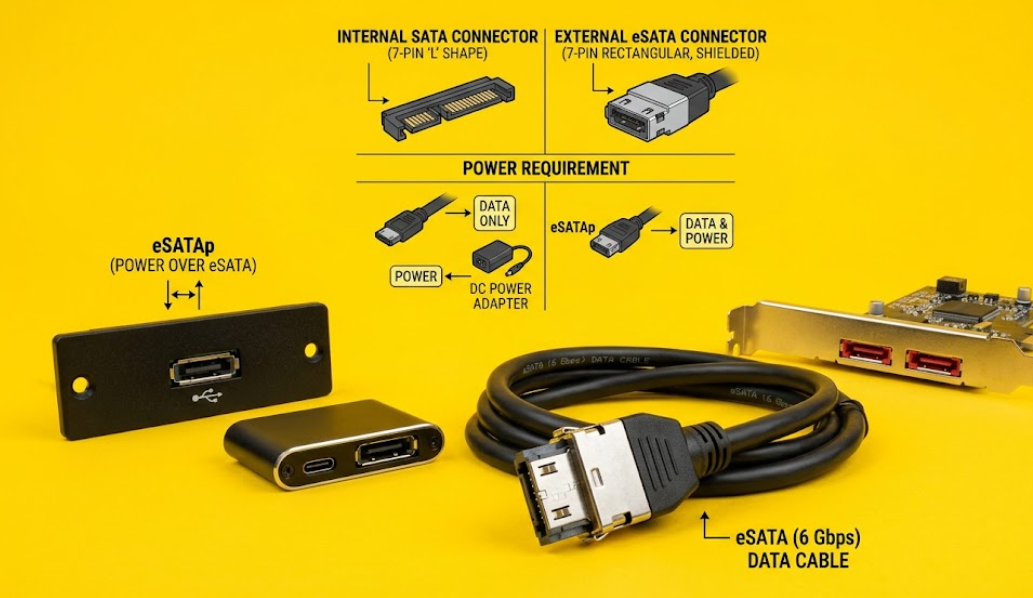
The eSATA port is physically different from internal SATA ports. It uses a reinforced connector designed for external use. The cable is shielded to prevent signal interference.
The design ensures stable connections even during continuous high speed data transfer. Unlike USB connectors, eSATA connectors are less likely to experience performance drops due to protocol translation.
Data Transfer Mechanism
eSATA transfers data using the SATA protocol. This means data flows directly between the storage device and the system chipset.
There is no conversion layer between the device and the computer. This direct communication reduces delay and improves throughput. Typical speeds reach up to 6 gigabits per second depending on the SATA generation supported by the system.
eSATA vs USB and SATA Comparison
eSATA is often compared with USB and internal SATA connections. Each interface serves different performance and usability needs.
USB is more flexible and widely supported. SATA is used internally for maximum performance. eSATA sits between both by offering SATA level speed in an external format.
Performance differences
eSATA delivers faster and more stable performance than USB 2.0 and early USB 3.0 implementations in older systems.
However, modern USB 3.2 and USB4 standards have reduced this advantage. These newer USB versions now match or exceed eSATA speeds while offering additional features such as power delivery.
SATA remains faster in internal use because it avoids external cable limitations. eSATA performance is slightly reduced due to external shielding and cable length.
Use cases
eSATA is mainly used in professional environments where consistent transfer speed is important.
Common use cases include video editing studios, server backup systems, and forensic data analysis. USB dominates consumer usage due to simplicity and universal compatibility.
Advantages of eSATA
eSATA provides several technical advantages in storage environments.
It delivers high transfer speed similar to internal SATA drives. It maintains stable performance during long data transfers. It reduces CPU overhead by avoiding protocol conversion. It supports direct disk access for external storage devices.
Another advantage is reliability in continuous workloads. eSATA connections are less affected by software overhead compared to USB interfaces in older systems.
Limitations of eSATA in 2026
eSATA has several limitations in modern computing environments.
It does not provide power through the cable. External devices require separate power sources. This reduces portability compared to USB powered drives.
It lacks universal compatibility. Many modern laptops and desktops no longer include eSATA ports. USB C has replaced it in most consumer devices.
It also lacks advanced features such as hot swapping management and integrated charging found in modern interfaces.
Because of these limitations, eSATA is now considered a legacy technology.
Where eSATA is Still Used Today
eSATA is still present in specific professional and industrial systems.
It is used in older workstation setups where upgrading hardware is not feasible. It is also used in archived storage systems that rely on stable SATA based connections.
Some enterprise environments still use eSATA for dedicated backup arrays. These systems prioritize stability over modern connectivity features.
In 2026, its usage is limited but not completely obsolete.
Frequently Asked Questions
What is the main purpose of eSATA
eSATA is used to connect external storage devices with SATA level speed and stability.
Is eSATA faster than USB
eSATA is faster than older USB standards but not faster than modern USB C and USB4.
Does eSATA provide power to devices
eSATA does not provide power and requires an external power source for drives.
Is eSATA still used in modern computers
eSATA is rarely used in modern consumer devices but still exists in legacy professional systems.
What replaced eSATA technology
USB C and Thunderbolt have largely replaced eSATA due to higher speed and better flexibility.
Conclusion
eSATA remains an important part of storage interface history and still supports specific professional systems in 2026. It delivers stable SATA level performance in external environments. Modern interfaces have replaced it in most consumer devices, yet eSATA continues to serve reliable roles in legacy storage and enterprise backup solutions where consistency is required.